
When strategizing, consider these areas of social sustainability:
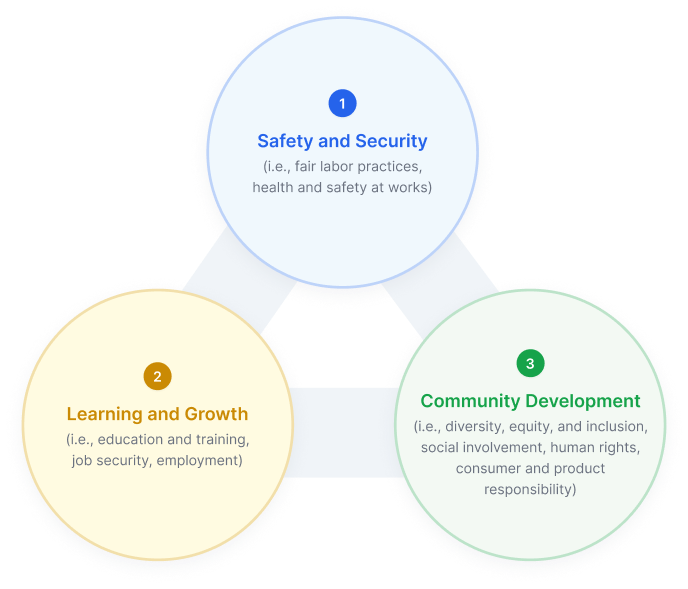
Blocker and colleagues’ (2025) work on purpose‐driven business models shows that companies can align their daily activities with a clear social purpose, not just profit, by defining why they exist, who they are, and how they create value for all stakeholders, — a perspective built around “purpose logic, purpose identity, and purpose strategy.”
For small and medium-sized firms, this means embedding social sustainability directly into their core purpose, such as committing to fair opportunities, safe working conditions, or serving diverse customer groups, and then letting this purpose guide small, practical decisions (e.g., inclusive communication, equitable task distribution, community‐aware services).
Porter and Kramer’s (2018) concept of shared value argues that companies become more competitive when they create business value and social value at the same time, rather than treating them as separate goals.
For small and medium-sized firms, strategizing with shared value means identifying how social sustainability strengthens the business, such as reaching new customer segments, improving problem‐solving through diverse teams, or increasing productivity by supporting employees’ needs, so DEI becomes a source of innovation and not just a compliance activity.
Firms can use purpose‐driven thinking to make social sustainability part of “who we are,” and use shared value thinking to make social sustainability part of “how we grow.” These approaches help smaller firms treat social sustainability as a practical strategy for stronger relationships, better performance, and long‐term sustainability, not just an add‐on or obligation.
Social sustainability can be considered in these aspects of strategic management in small and medium-sized firms:
- Firm’s strategy making (keywords: strategizing, strategic business development, business model development, growth, expansion)
Example: The firm can add social sustainability to its vision or strategic goals by, for example, committing to expanding into new markets by serving diverse customer groups and ensuring fair, safe, and inclusive work for all employees. The firm can also strategize, reflecting purpose‐driven strategic thinking where societal value and business value reinforce each other. When planning growth, the company may decide to develop new services accessible to customers with disabilities or to partner with community groups, such as migrants, aligning expansion with social impact.
- Firm’s strategy implementation (keywords: strategy communication, strategic practices at work, key performance indicators, managing operations)
Example: When managers consider social sustainability during strategy implementation, managers, for example, communicate the strategy in simple language, using diverse means of communication (suitable for linguistically or neurodiverse employees), and link it to daily practices. Moreover, managers can consider including relevant, work-related, social sustainability-focused Key Performance Indicators (e.g., fair workload distribution or inclusive meeting routines). This strengthens credibility and reduces the common social sustainability awareness gap.
- Firm’s human resource management (keywords: recruitment, promotion, appraisals, teamwork, leadership, whistleblowing, integration, skill development, knowledge sharing)
Example: Company may consider how diverse perspectives, diverse skills, competencies, profiles, and mindsets can support a firm’s growth. For example, when planning expansion to a specific country, companies may hire an international talent who is from that country. Even without an HR department, the firm may adopt fair and transparent people practices, such as inclusive job ads, buddy-based onboarding, clear reporting channels, and equitable access to training, addressing areas where smaller firms often show inconsistency. When promoting employees, managers use a simple skills-based checklist rather than informal judgments, ensuring equal opportunity for underrepresented staff. More details on human resource management best practices are available here (best practices for people management).
- Firm’s product or service development (keywords: accessibility of product or service, customer relationships, customer needs)
Example: The firm can incorporate social sustainability into its offerings by designing products/services that are accessible and respectful of diverse customers’ needs. This supports shared value creation: this benefits society and simultaneously enhances the company’s competitiveness. For instance, a firm redesigns its service instructions in clearer, multilingual formats to better serve migrant customers and reduce misunderstandings. Or, the firm may add visual instructions, larger fonts, or simple icons so older people or people with different literacy or language levels can understand how to use the product. In addition to written instructions, the company may develop a video tutorial to better serve neurodiverse customers. If customers visit the firm’s workplace, ensuring inclusion of customers with diverse physical abilities, the firm could make entrances step-free where possible, ensure accessible restrooms, and provide seating in waiting areas.
- Legal compliance and adherence to regulatory frameworks and sustainability standards
Example: The company should stay aware of basic social sustainability obligations and legal responsibilities. The company may review local labor and nondiscrimination laws annually, ensure an accessible work environment for all body types and religious needs, and communicate reporting procedures clearly to employees. Learn more about legal compliance and social sustainability — here (compliance and governance examples).
Company cases on social sustainability and strategic management:
- DEI4SME blog (2024): “Is there a small or medium business that champions diversity, equity, and inclusion? Explore some inspiring examples.”
- Arif, S., & Butkevičienė, J. (2026). Resilience on the Menu: A Migrant Woman’s Path to Inclusive Entrepreneurship. Zenodo.
- Šilenskytė, A., & Delecour, T. (2025). Fostering diversity and inclusion by making jewelry from trash: The power of a single entrepreneur. Zenodo.
- Ye, Y. W. (2024). Geely: Achieving Social Sustainability Goals Through Stakeholder Participation. In: Šilenskytė, A., Cordova, M., Schmitz, M. A., Toh, S. M. (eds) The Palgrave Handbook of Social Sustainability in Business Education. Palgrave Macmillan, Cham.
- (more coming soon)
You may also consider these videos and insights:
- Šilenskytė, A. (2022). Lecture: Diversity Management in Organizations. [Video].
- Šilenskytė, A. (2022). Lecture: Implementing Diversity Management in Organizations. [Video].
- DEI4SME Hackathon I: K. Kovalonoks, M. Goswami — Promoting DEI via communication
- FIIF event presentation (May 2024): DEI4SME — Corporate Sustainability: Perspectives of SMEs and Business Students
- Serrano, J. C., Diduc, S., Šilenskytė, A., Stephens, M., Nava-Aguirre, K. M. (2024). Fostering Awareness of Social Sustainability in Digital Business (p. 147–166). In: Šilenskytė, A., Cordova, M., Schmitz, M. A., Toh, S. M. (eds) The Palgrave Handbook of Social Sustainability in Business Education. Palgrave Macmillan, Cham.
Materials on this page are constantly updated. You are welcome to revisit to learn new best practices.
Would you like to suggest the best practice that worked for you or a valuable resource relevant to this area of engagement? Welcome to share them with us by contacting: [email protected].